
Do You Really Need an FDA Regulatory Lawyer? Here’s the Truth for Scaling Startups
March 18, 2026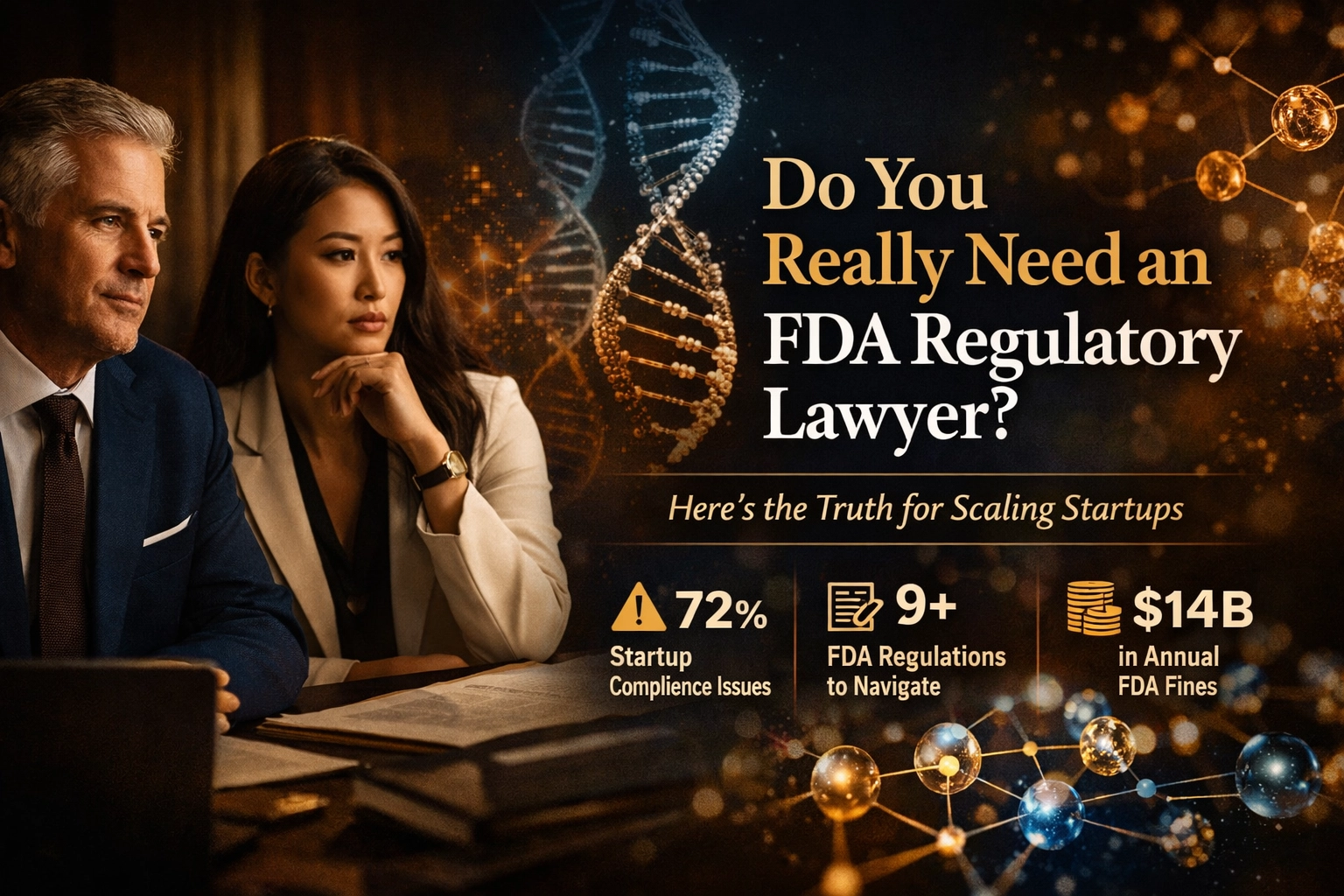
Scaling a startup is a bit like trying to build a plane while it’s already 30,000 feet in the air. You’re juggling investor expectations, product development, and the constant pressure to hit your next milestone. But when your product falls under the jurisdiction of the Food and Drug Administration (FDA), the complexity doesn't just double, it scales exponentially.
One of the most common questions we hear from founders and C-suite executives at growing biotech, med-tech, and food-tech companies is: "Do we really need an fda regulatory lawyer yet, or can we just stick with our consultant?"
The answer isn't a simple "yes" or "no." It’s about timing, risk management, and understanding the Return on Investment (ROI) of specialized legal counsel versus a generalist approach. If you’re at the helm of a scaling startup, here is the unvarnished truth about when to bring in the big guns.
The Early Days: Why Consultants Often Win (Initially)
In the seed stage, every dollar counts. If you’re still in the pre-revenue phase or have just closed a small seed round, hiring a high-powered law firm might feel like overkill. At this stage, your primary goal is determining the regulatory "pathway."
Regulatory consultants are fantastic for this. They can help you navigate the 510(k) process, look into De Novo classifications, or help you figure out if your software-as-a-medical-device (SaMD) even needs FDA oversight. They are often more cost-effective for foundational work and technical documentation.
However, a consultant’s job is generally to follow the manual. They are experts at the mechanics of compliance. But as your startup begins to scale and the stakes move from "concept" to "commercialization," the limitations of a consultant start to show.
When the "Regulatory Wall" Hits
As you move toward Series A and beyond, you aren't just filing paperwork anymore; you’re managing a brand and a business. This is where an fda regulatory lawyer becomes less of a luxury and more of a strategic necessity.
There are three specific moments when "good enough" compliance isn't good enough anymore:
- Challenging an FDA Decision: If the FDA refuses to approve your regulatory pathway or issues a Refuse to Accept (RTA) notice while your competitor sails through, a consultant can't litigate or provide the same level of administrative challenge that a lawyer can.
- Investor Due Diligence: Sophisticated investors want to know that your regulatory strategy is bulletproof. They look for legal opinions, not just "best guesses." Having a specialist vet your practice areas ensures that your "exit" or "IPO" isn't derailed by a hidden compliance flaw.
- High-Stakes Enforcement: If you receive a Warning Letter or an Untitled Letter, the clock starts ticking. You have a very narrow window to respond before things get ugly.

Specialized Counsel vs. Generalists: The ROI Breakdown
Many startups assume their general corporate counsel (the folks who handled their incorporation and employment contracts) can handle the FDA stuff. This is a dangerous, and expensive, assumption.
The FDA is a beast unlike any other. It doesn't follow standard "courtroom" logic. It follows its own set of administrative laws, guidances, and shifting political priorities.
The Generalist Tax
When a generalist lawyer tries to handle an FDA matter, you end up paying for their "learning curve." They might spend ten hours researching a concept that an fda regulatory lawyer understands in ten minutes. Worse, they might miss a nuance in a "Guidance Document" that isn't technically law but is treated as law by the Agency.
The Specialist ROI
The ROI of a specialist isn't just about avoiding fines; it's about time-to-market. If a specialist helps you avoid one additional "Request for Information" (AI request) during a submission, you might save three to six months of delay. In the startup world, six months of market exclusivity can be worth millions.

Scaling: From "Passing" to "Thriving"
As your company grows, your regulatory needs will shift from pre-market approval to post-market survival. This includes everything from marketing compliance (making sure your sales team isn't making off-label claims) to managing adverse event reporting.
For companies in specialized niches, such as compounding pharmacies or those working in rare disease, the regulations are even more granular. In these sectors, one misstep in labeling or a slight change in a manufacturing process can lead to a product seizure or a massive recall.
An FDA lawyer doesn't just tell you "no." A good one tells you "how." They help you build a compliance system that is robust enough to satisfy an auditor but flexible enough to let your company actually innovate.
The Transition: In-House vs. Outside Counsel
Eventually, you’ll reach a point where you need a full-time Regulatory Affairs (RA) person in-house. This usually happens when the volume of work makes external consultants too expensive.
However, even with a stellar in-house RA team, most scaling startups keep an outside fda regulatory lawyer on speed dial. Why? Because you need an objective third party to provide a "sanity check" on high-risk decisions. Plus, legal privilege is a powerful tool. Conversations with your lawyer about potential compliance gaps are privileged; conversations with your consultant are not. If things ever go south, that distinction is everything.

Strategic Considerations for the C-Suite
If you’re an executive like Sarah: a Chief Compliance Officer or VP of Regulatory Affairs: you know that your job isn't just about following rules; it’s about managing risk for the board.
When evaluating whether to bring on a specialized firm like The FDA Law Solution, ask yourself these three questions:
- Is our product "novel"? If you’re doing something the FDA hasn't seen before, you need a legal strategist, not a form-filler.
- Are we approaching a major milestone? Don't wait until the week before your submission to find a lawyer.
- What is the cost of a 10% delay? If a 10% delay in your launch costs more than the legal fees, the lawyer is a profit center, not an expense.
Conclusion
The "truth" for scaling startups is that you can probably get by without an fda regulatory lawyer during your earliest days. But once you start moving from the lab to the market, the risk profile changes.
The FDA doesn't care if you're a "scrappy startup." They care about the law. Having a partner who knows how to navigate the intersection of science, business, and federal regulation is often the difference between a successful exit and a cautionary tale.
If you’re ready to stop guessing and start scaling with confidence, it might be time to look at your regulatory strategy through a legal lens.

Categories: Regulatory Strategy, Compliance Systems
Contact us today: Get in touch with The FDA Law Solution
Disclaimer: The information on this blog is for general informational purposes only and does not constitute legal advice. Reading these posts or contacting us through this site does not create an attorney-client relationship. Because FDA regulations and legal standards change quickly, this content may not reflect the most current developments. Always consult with a qualified attorney regarding your specific legal or regulatory situation.