
7 Mistakes You’re Making with 503B Compounding Pharmacy Compliance (and How to Protect Your License)
June 9, 2026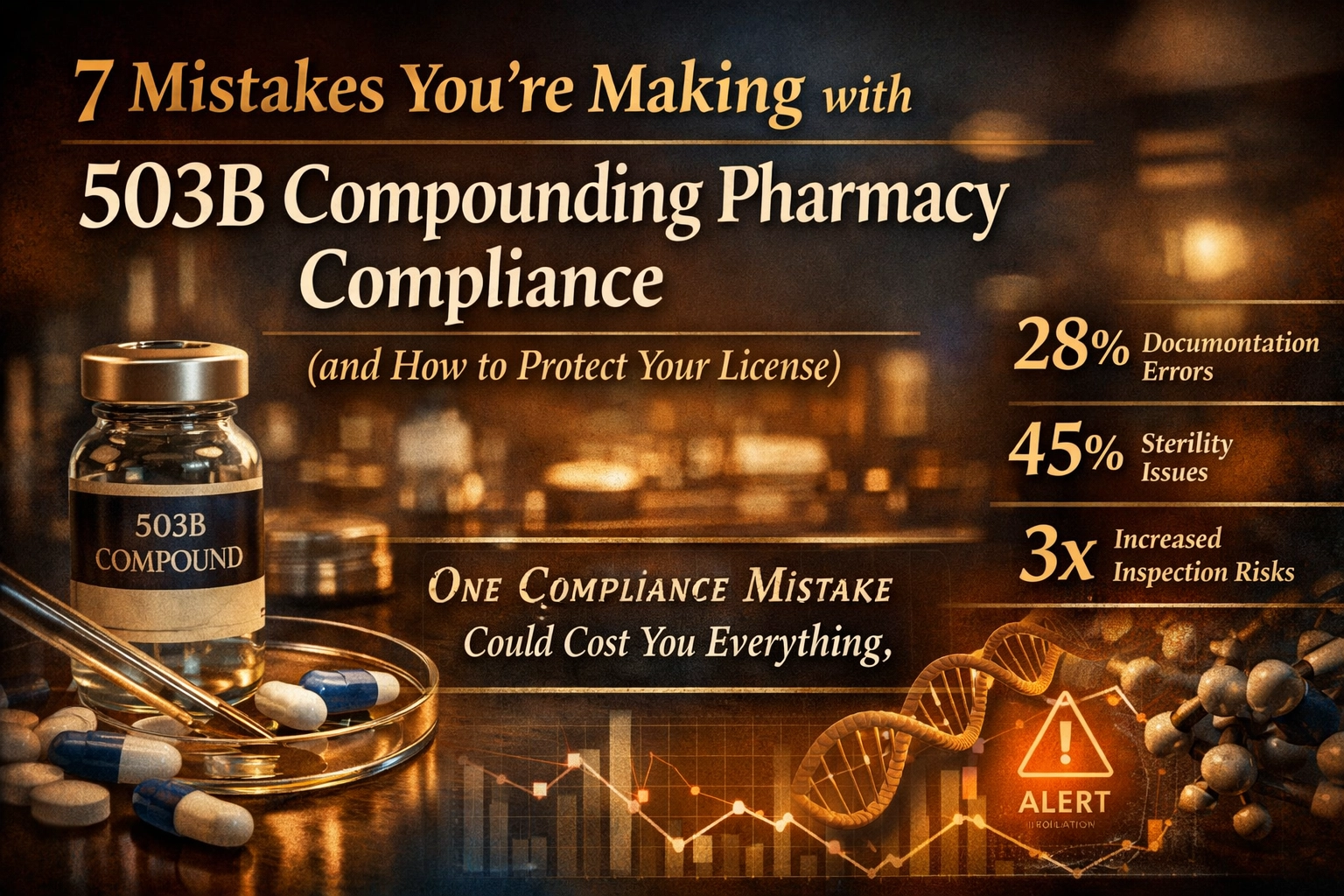
Let’s be honest: making the jump from a 503A traditional pharmacy to a 503B outsourcing facility is like moving from a local go-kart track to the Formula 1 circuit. The stakes are higher, the speed is faster, and the rulebook: specifically Current Good Manufacturing Practice (CGMP): is significantly thicker.
Many facilities step into the 503B space thinking their existing pharmacy standards will carry them through. Unfortunately, that’s a fast track to an FDA Form 483 or, worse, a Warning Letter. Maintaining 503B compounding pharmacy compliance isn't just about following recipes; it's about proving, through data and documentation, that every single vial you ship is safe, sterile, and pure.
If you’re a C-suite executive or a compliance lead, you know that a single slip-up can jeopardize your facility’s registration and your professional reputation. Here are the seven most common mistakes we see 503B facilities making: and how you can fix them before the FDA knocks on your door.
1. Treating Environmental Monitoring Like a "Box-Ticking" Exercise
In the 503A world, you might get away with periodic air sampling. In the 503B world, your Environmental Monitoring (EM) program is the heartbeat of your facility. A common mistake is failing to establish a robust "state of control." The FDA doesn't just want to see that your air is clean today; they want to see the trends over the last six months.
Facilities often lack adequate sampling locations or fail to perform monitoring during "worst-case" conditions: like full production shifts with maximum personnel. If your EM data is patchy or if you aren't investigating "Action Level" excursions with the intensity of a forensic investigator, you’re sitting on a compliance landmine.
2. The "Essentially a Copy" Trap
One of the biggest regulatory hurdles for 503B facilities is the prohibition against compounding drugs that are "essentially a copy" of an FDA-approved drug. You can’t just compound whatever is popular. To stay compliant, you must strictly follow the FDA’s Bulk Drug Substances lists.

We often see facilities compounding products that are commercially available simply because they are cheaper or "in demand." Unless that drug is on the FDA’s official shortage list: or there is a documented clinical difference for an individual patient (which is rare for bulk 503B production): you are playing with fire. If the drug comes off the shortage list on a Tuesday, your production of that "copy" needs to stop immediately.
3. Weak Batch Records and CGMP Documentation
If it isn’t written down (and written down correctly), it didn't happen. Traditional pharmacy records often fall short of the granular detail required by CGMP. 503B facilities must track every critical process parameter.
Common documentation failures include:
- Missing signatures for "witnessed" steps.
- Lack of clear in-process controls.
- Vague descriptions of deviations.
- Failure to reconcile labels (how many were printed vs. how many were used vs. how many were destroyed).
Your batch records should tell a complete story of the product’s journey, from the raw bulk substance to the final sterile vial.
4. Ignoring the "Root" in Root Cause Analysis (CAPA)
When a batch fails a sterility test or an environmental sample comes back "hot," you can’t just say, "We cleaned the room and moved on." That’s a one-way ticket to a Warning Letter.
The FDA expects a Corrective and Preventive Action (CAPA) system that actually works. Most facilities identify the what but fail to find the why. Was the contamination due to poor gowning technique? Is the HVAC system failing? Is the cleaning agent no longer effective? Without a deep-dive root cause analysis, the FDA will view your compliance efforts as superficial and ineffective.
https://cdn.marblism.com/EMgAxnlun1V.webp

5. The "Quality Unit" Lacks Real Power
In many struggling 503Bs, the Quality Unit reports to the Production Manager. That is a massive red flag. For true 503B compounding pharmacy compliance, your Quality Department must be independent.
The Quality Unit needs the authority to:
- Reject batches without being pressured by sales targets.
- Stop production if an environmental excursion is detected.
- Approve or reject all procedures affecting identity, strength, quality, and purity.
If your Quality team is treated as an afterthought or a "rubber stamp," the FDA will notice during their inspection of your management oversight systems.
6. Sterile Processing and Media Fill Failures
Aseptic processing is the most critical part of 503B operations. A common mistake is failing to perform "Media Fills" (Process Simulations) that accurately reflect real-world production.
If your team performs a Media Fill with two people in the room, but your actual production has four people moving around, your simulation is invalid. The FDA wants to see that you’ve challenged your process. This includes validating the hold times for sterile bulk and ensuring that your equipment: like autoclaves and depyrogenation ovens: is fully qualified and regularly re-validated.
https://cdn.marblism.com/MW-kvEqbgIo.webp

7. Scaling Up Without a Regulatory Roadmap
Success can be a double-edged sword. We often see facilities invest millions in automated filling lines or high-speed labeling machines without considering the regulatory implications.
Every time you change a piece of equipment or scale up your batch size, you need to validate that change. Many 503Bs scale too fast, outstripping their Quality Unit’s ability to keep up. This leads to "drift" in standards, where the speed of production starts to compromise the rigor of compliance. Before you buy that new piece of gear, you need a plan for how it will be qualified under CGMP standards.
How to Protect Your License and Your Business
Compliance isn't a destination; it's a constant state of vigilance. To protect your license, you need to move from a reactive "fix-it" mindset to a proactive "prevent-it" strategy.
- Conduct "Mock" Inspections: Don't let the FDA be the first people to find your flaws. Bring in outside experts to perform a rigorous compounding pharmacy audit.
- Invest in Training: Your staff are your biggest risk and your best defense. Regular, documented training on gowning, aseptic technique, and CGMP is non-negotiable.
- Monitor the Shortage List Daily: Your business model for certain products can evaporate overnight. Stay ahead of the FDA’s drug shortage updates.
- Prioritize the Quality Unit: Give your QA team the resources and the autonomy they need to do their jobs effectively.

Conclusion
The 503B space offers incredible opportunities for pharmacies to scale and serve hospitals and clinics on a massive level. But that opportunity comes with the burden of pharmaceutical-grade oversight. By avoiding these seven common mistakes and treating 503B compounding pharmacy compliance as a core business function rather than a legal hurdle, you can build a sustainable, respected, and profitable facility.
If you’re worried about an upcoming inspection or need to overhaul your current compliance systems, don’t wait for a 483 to land on your desk. Strategic planning today prevents legal headaches tomorrow.
For more information on how to navigate these complex regulations, visit our practice areas page or contact us directly to discuss your facility's specific needs.
Disclaimer: The information on this blog is for general informational purposes only and does not constitute legal advice. Reading these posts or contacting us through this site does not create an attorney-client relationship. Because FDA regulations and legal standards change quickly, this content may not reflect the most current developments. Always consult with a qualified attorney regarding your specific legal or regulatory situation.